
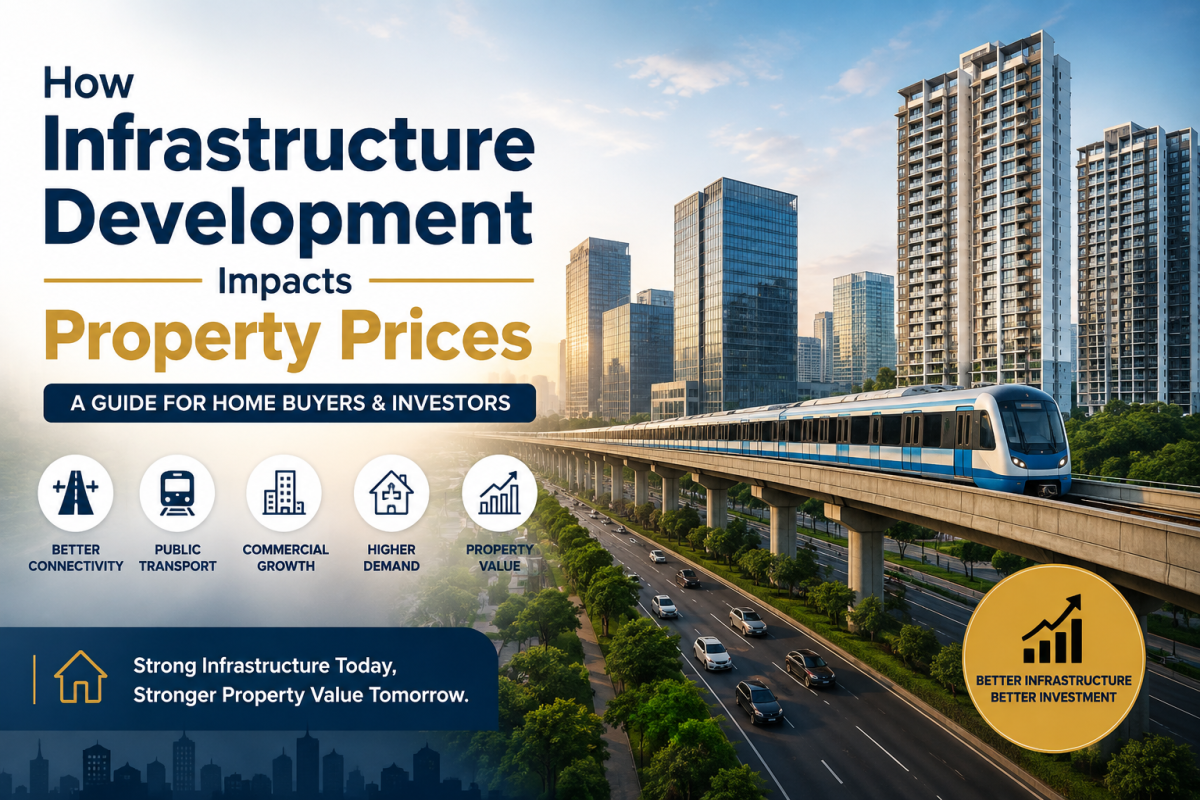
How Infrastructure Development Impacts Property Prices: A Guide for Property Buyers and Investors
21 Jul, 2026
When people evaluate a Residential property, the building itself is only one part of the decision. The surrounding infrastructure can have an equally important influence on convenience, demand, and long-term property value. Roads, public transport, schools, hospitals, shopping areas, airports, and upcoming infrastructure projects can gradually transform an area and make it more attractive to homebuyers.
The same principle applies when evaluating a Commercial property. Better connectivity can bring more customers, employees, businesses, and investment into a locality. As accessibility improves, previously overlooked areas can become active residential and business destinations. This is why understanding infrastructure development is important before making a real estate purchase or investment.
What Is Infrastructure Development in Real Estate?
Infrastructure development refers to improvements and new projects that make a location easier and more convenient to live, work, and conduct business in.
Some examples include:
- • New roads and highways
- • Metro and rapid transit networks
- • Flyovers and bridges
- • Airports and railway connectivity
- • Schools and educational institutions
- • Hospitals and healthcare facilities
- • Shopping centres and entertainment zones
- • Business parks and IT hubs
- • Water supply and drainage systems
- • Electricity and digital connectivity
- • Public spaces and recreational facilities
When several of these improvements happen together, they can significantly change the character and attractiveness of a neighbourhood.
Why Does Infrastructure Affect Property Prices?
Property value is closely connected to location, accessibility, demand, and future potential. Infrastructure can influence all four.
Imagine two properties that are similar in size and quality. One is located close to a major road, public transport, schools, healthcare facilities, and shopping areas, while the other is in a less connected location.
Even if the properties are similar, buyers may prefer the better-connected location because it can reduce daily travel time and offer greater convenience.
As more people want to live or establish businesses in an area, demand can increase. Increased demand can then contribute to higher property prices and rental values.
1. Better Connectivity Can Increase Demand:
Connectivity is one of the biggest factors influencing real estate demand.
A new highway, metro station, bridge, or improved road network can make an area easier to reach. Locations that once seemed far away may become more accessible to major employment and commercial centres.
For homebuyers, this can mean shorter or more convenient commutes. For businesses, better connectivity can make it easier for employees, customers, suppliers, and clients to reach their premises.
As accessibility improves, the number of people considering properties in the area may increase.
2. Metro and Public Transport Can Transform Neighbourhoods:
• Public transportation can have a particularly strong impact on urban real estate.
• A new metro line or improved bus network can connect residential neighbourhoods with offices, educational institutions, shopping destinations, and major city hubs.
• Properties located within convenient reach of public transport may become more attractive to buyers and tenants who want alternatives to private vehicles.
• However, proximity should not be considered in isolation. Buyers should also evaluate factors such as noise, traffic, parking availability, neighbourhood planning, and the actual quality of connectivity.
3. New Roads and Highways Can Open Up Growth Corridors:
• Major road infrastructure can create new development opportunities.
• When an area gains better access to an existing city centre or another major economic zone, developers may begin considering the location for new residential communities, offices, retail spaces, warehouses, and other projects.
• Over time, this can create a growth corridor where infrastructure and real estate development support each other.
• But investors should remember that an announced road or highway project is not the same as a completed project. The timeline, execution, connectivity, and surrounding development all matter.
4. Commercial Growth Can Support Residential Demand:
• Infrastructure development often creates a ripple effect.
• Suppose a new business district, technology park, industrial zone, or commercial centre develops in an area. The arrival of businesses can create employment opportunities.
• Employees may then look for homes nearby or in locations with convenient transport connections.
• This can increase demand for rental homes as well as properties for purchase.
In this way, commercial development and residential real estate can grow together, particularly when supported by strong infrastructure.
5. Social Infrastructure Matters Too:
Infrastructure isn't limited to roads and transportation.
People also want convenient access to everyday facilities such as:
- • Schools and colleges
- • Hospitals and clinics
- • Supermarkets
- • Restaurants and cafes
- • Banks and financial services
- • Parks and recreational spaces
- • Fitness and wellness centres
A neighbourhood with a good combination of physical and social infrastructure can become more attractive for families, professionals, and businesses.
For long-term property decisions, these everyday conveniences can be just as important as a major highway or metro station.
6. Infrastructure Can Influence Rental Demand:
• Infrastructure improvements don't only affect property purchase prices. They can also influence rental demand.
• When an area becomes better connected to employment hubs, educational institutions, and commercial centres, more people may consider renting there.
• For property investors, this can make rental demand an important factor to monitor.
• Instead of looking only at today's rental rates, investors should consider how the surrounding area is expected to develop over the coming years.
7. Future Infrastructure Can Create Investment Opportunities:
One reason infrastructure is closely watched by real estate investors is its potential to change an area's future.
An area that currently has limited development may attract attention when significant infrastructure projects are planned nearby.
However, investing purely because of an upcoming project can be risky.
Before making a decision, investors should research:
- • Whether the project has received the required approvals
- • Its expected completion timeline
- • The actual location and accessibility
- • Government and developer plans
- • Existing infrastructure
- • Current property demand
- • Rental potential
- • Future competing developments
The goal should be to identify sustainable growth, rather than simply following a short-term property trend.
8. Infrastructure Doesn't Automatically Mean Higher Prices:
A common misconception is that every new infrastructure project will immediately increase property prices.
Real estate markets are more complicated.
Prices can be influenced by several factors, including:
Demand + Location + Infrastructure + Employment + Supply + Property Quality + Economic Conditions
For example, a new road may improve connectivity but have little effect on prices if there is weak demand for the area.
Similarly, excessive new construction could increase property supply and affect how quickly prices rise.
Therefore, infrastructure should be considered as one important part of a larger real estate evaluation.
9. The Impact Can Differ for Residential and Commercial Markets:
Infrastructure can affect different property segments in different ways.
Residential Real Estate
Homebuyers generally look for:
- • Easy commuting
- • Nearby schools
- • Healthcare facilities
- • Public transportation
- • Shopping and daily conveniences
- • Safe and well-developed neighbourhoods
Commercial Real Estate
Businesses may prioritise:
- • Customer accessibility
- • Employee connectivity
- • Visibility
- • Parking
- • Proximity to business hubs
- • Logistics and transportation
- • Availability of supporting services
Understanding these differences can help buyers and investors select properties based on their actual objectives.
10. How Buyers Can Evaluate an Infrastructure-Driven Property Opportunity:
Before purchasing a property in a developing location, don't look only at the brochure or the proposed infrastructure project.
Take a wider view.
Check Current Connectivity:
Visit the location and assess the roads, traffic, public transport, and travel time during different parts of the day.
Research Upcoming Projects:
Look for reliable information about planned infrastructure instead of relying only on advertisements or informal claims.
Study Employment Growth:
New offices, business parks, industrial areas, and commercial centres can be strong indicators of future demand.
Look at Existing Amenities:
A location with schools, hospitals, retail, and recreational facilities may offer greater day-to-day convenience.
Compare Property Prices:
Compare the property with similar properties in nearby established and developing areas.
Consider the Long-Term Picture:
Real estate is generally a long-term decision. Think beyond the next few months and consider whether the location has the fundamentals to remain desirable.
The Bigger Picture: Infrastructure and Real Estate Growth:
Infrastructure and real estate development often influence each other.
A new transport link can attract people and businesses. Growing population and business activity can encourage further development. New development can then create demand for better roads, public transport, schools, healthcare, and other services.
This creates a cycle of connectivity → development → demand → investment → further infrastructure.
For buyers and investors, understanding this cycle can provide a better perspective on why some locations experience rapid transformation while others grow more gradually.
Final Thoughts:
Infrastructure development can play a significant role in shaping property markets. Better roads, public transportation, employment hubs, social amenities, and connectivity can improve a location's overall appeal and potentially influence property demand, rental opportunities, and long-term values.
However, infrastructure should never be the only reason to purchase a property. A smart real estate decision considers the complete picture — location, current demand, future development, property quality, pricing, connectivity, amenities, and investment objectives.
Whether you are searching for a home or evaluating an investment opportunity, understanding the infrastructure story behind a location can help you make a more informed decision.
The best property opportunity isn't always where development is happening fastest — it can be where infrastructure, demand, and sustainable growth come together.
Latest Posts

Is Adani Shantigram a Good Place to Buy Property in 2026?

Ambli vs. Bodakdev: Which Is Better for Buying a Luxury Home in Ahmedabad?

The Future of Ahmedabad Real Estate: Emerging Trends to Watch in 2027

Gated Community vs. Standalone Apartment in Ahmedabad: Which Should Homebuyers C...

Paarijat Eros by B Safal – Luxury 4 BHK Apartments in Ahmedabad
Our Approach
Why buy through Sovereign Realtors?
Skip the hassle of browsing endless portals, broadcasting your phone number, and dodging daily sales calls. At Sovereign Realtors, the Company owner who curates only the opportunities that truly match your requirements.
Why Discerning Investors Choose Us
Direct Developer Access
We deal directly with builders and key decision-makers—not middle-tier sales employees—giving you authentic, transparent insights.
Time-Saving Curation
No fluff or cold calls. Only handpicked, highly relevant investments.
Relationships Over Transactions
Most of our business comes from client referrals because we measure success by trust earned, not volume processed.